Smart Thermostat Rebates: Utility Programs, Eligibility & How to Claim
Smart thermostat rebates are usually offered directly by your electric or gas utility, and are one of the easiest incentives to claim. Some utilities add a bonus if you enroll in a demand-response program that briefly adjusts your temperature during peak events. Rebates are typically modest and tied to a list of qualifying models.
Smart Thermostats incentives at a glance (2026)
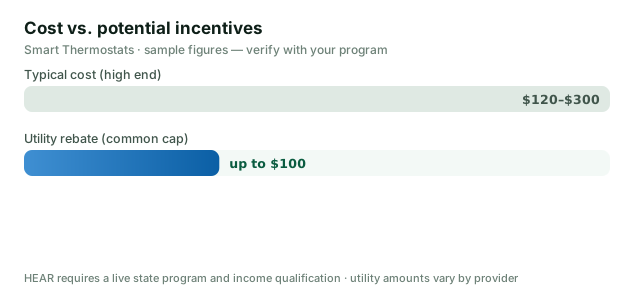
- Typical project cost: $120–$300
- Federal tax credit: None for 2026 installs — the 25C/25D credits ended December 31, 2025
- IRA HEAR rebate: Not a HEAR measure — usually covered under a state HOMES whole-home rebate instead
- IRA HOMES rebate: Generally not the primary pathway for this upgrade
- Utility rebates: Commonly available from electric/gas providers and usually stack with IRA rebates
Estimate your smart thermostats incentives
Sample dataWhat counts as a qualifying smart thermostats project
- Qualifying Wi-Fi / connected thermostat models on the utility's list
- Enrollment in a demand-response or 'bring your own thermostat' program (optional bonus)
- Purchase within the program dates
Federal update for 2026
Federal home energy tax credits (25C and 25D) ended December 31, 2025. The One Big Beautiful Bill Act (Public Law 119-21, signed July 4, 2025) terminated the Energy Efficient Home Improvement Credit (Section 25C) and the Residential Clean Energy Credit (Section 25D). No 25C or 25D credit is available for property placed in service on or after January 1, 2026. Equipment placed in service by December 31, 2025 can still be claimed on your 2025 return (IRS Form 5695), and unused 25D credit generally carries forward. This is not tax advice — confirm with the IRS or a tax professional.
What's available now: The Inflation Reduction Act funds roughly $8.8 billion in Home Energy Rebates through two state-run programs: HOMES (Home Efficiency Rebates) and HEAR/HEEHRA (Home Electrification and Appliance Rebates). These rebates were not repealed by the 2025 tax law and remain the primary federal savings pathway. They are administered by each state's energy office and launch on different timelines; funding runs until it is used up or September 30, 2031. Smart Thermostats generally falls under a state HOMES whole-home efficiency rebate (based on energy savings) rather than the HEAR appliance program.
Recent change: A mid-2026 U.S. Department of Energy update narrowed HEAR: rebates no longer cover 'fuel switching' (for example, replacing a gas furnace with a heat pump) and now focus on upgrading existing electric equipment to more efficient electric models. New HVAC rebates may also require insulation and air sealing to be done at the same time. Exact rules and timing vary by state.
Federal tax credits for this upgrade (ended)
Ended December 31, 2025These federal credits were available through 2025. They're shown here for reference and for anyone claiming a 2025 install — they do not apply to work done in 2026 or later.
Energy Efficient Home Improvement Credit IRC §25C
No longer availableWas 30% of project cost, up to $1,200 per year (no lifetime limit), with a $600-per-item cap — and a higher $2,000 per year limit for heat pumps and heat pump water heaters. Home energy audits up to $150. Existing homes only.
Not available for property placed in service on or after January 1, 2026. Work completed by December 31, 2025 can still be claimed on your 2025 return.
Residential Clean Energy Credit IRC §25D
No longer availableWas 30% of cost with no dollar cap — for solar panels, solar water heating, battery storage, small wind, fuel cells, and geothermal heat pumps. Was originally scheduled to run through 2034 before it was ended early.
Not available for expenditures made on or after January 1, 2026. Costs paid by December 31, 2025 can still be claimed on your 2025 return, and unused credit generally carries forward.
What about 2027 and 2028?
- No new federal home-energy tax credits are scheduled for 2027 or 2028. The 25C and 25D credits ended after 2025 and have not been replaced.
- The IRA-funded Home Energy Rebates (HOMES and HEAR) are scheduled to remain available through September 30, 2031, or until each state's funds run out — so they can still apply in 2026, 2027, and 2028 wherever a state's program is running.
- For home solar installed through a lease or power-purchase agreement, the separate Section 48E clean-electricity credit is scheduled to end for projects placed in service after December 31, 2027 (with exceptions for projects that began construction by July 4, 2026). This credit is claimed by the system owner, not the homeowner.
- Utility rebates and the Weatherization Assistance Program don't have a national expiration tied to the tax law and are expected to continue.
Plan your smart thermostats project like a pro
Start with the numbers: the rebate calculator estimates your stack, the Rebates renters can actually get guide covers the details, and the application playbook keeps the paperwork straight. Then confirm what's live in your state. Related upgrades worth pricing at the same time: weatherization and water heaters.