Missouri home energy rebates & incentives (2026)
Missouri hasn't opened its IRA Home Energy Rebate program (HOMES/HEAR) yet — it's in the design or launch phase — so the practical savings in Missouri right now come from utility rebate programs and, for income-qualified households, the Weatherization Assistance Program. The federal 25C and 25D tax credits ended after 2025 and no longer apply. This page explains what's available today and how to be ready the day Missouri's program opens.
Missouri has not yet opened its IRA Home Energy Rebate program (HOMES/HEAR) — it's in the design or launch phase. Check your state energy office for the timeline. Utility rebates and weatherization assistance are available in the meantime.
Missouri home energy incentives at a glance (July 25, 2026)
- IRA rebates (HOMES/HEAR) in Missouri: Not open yet — in design or launch phase
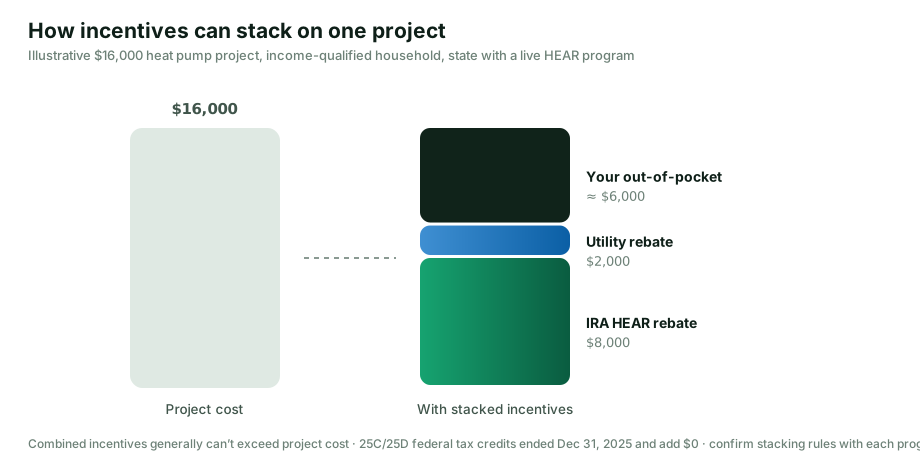
- HEAR rebate: Up to $14,000 per household for income-qualified residents (at or below 150% of area median income)
- HOMES rebate: Typically up to $8,000, all incomes, based on whole-home energy savings
- Federal tax credits (25C/25D): Ended December 31, 2025 — no federal home energy tax credit for 2026 installs
- Still available: Utility rebates from your electric/gas provider and free Weatherization Assistance for income-qualified households
Who runs Missouri's rebate programs
Federal update for 2026
Federal home energy tax credits (25C and 25D) ended December 31, 2025. The One Big Beautiful Bill Act (Public Law 119-21, signed July 4, 2025) terminated the Energy Efficient Home Improvement Credit (Section 25C) and the Residential Clean Energy Credit (Section 25D). No 25C or 25D credit is available for property placed in service on or after January 1, 2026. Equipment placed in service by December 31, 2025 can still be claimed on your 2025 return (IRS Form 5695), and unused 25D credit generally carries forward. This is not tax advice — confirm with the IRS or a tax professional.
What's available now: The Inflation Reduction Act funds roughly $8.8 billion in Home Energy Rebates through two state-run programs: HOMES (Home Efficiency Rebates) and HEAR/HEEHRA (Home Electrification and Appliance Rebates). These rebates were not repealed by the 2025 tax law and remain the primary federal savings pathway. They are administered by each state's energy office and launch on different timelines; funding runs until it is used up or September 30, 2031.
Recent change: A mid-2026 U.S. Department of Energy update narrowed HEAR: rebates no longer cover 'fuel switching' (for example, replacing a gas furnace with a heat pump) and now focus on upgrading existing electric equipment to more efficient electric models. New HVAC rebates may also require insulation and air sealing to be done at the same time. Exact rules and timing vary by state.
Federal tax credits (ended)
Ended December 31, 2025These federal credits were available through 2025. They're shown here for reference and for anyone claiming a 2025 install — they do not apply to work done in 2026 or later.
Energy Efficient Home Improvement Credit IRC §25C
No longer availableWas 30% of project cost, up to $1,200 per year (no lifetime limit), with a $600-per-item cap — and a higher $2,000 per year limit for heat pumps and heat pump water heaters. Home energy audits up to $150. Existing homes only.
Not available for property placed in service on or after January 1, 2026. Work completed by December 31, 2025 can still be claimed on your 2025 return.
Residential Clean Energy Credit IRC §25D
No longer availableWas 30% of cost with no dollar cap — for solar panels, solar water heating, battery storage, small wind, fuel cells, and geothermal heat pumps. Was originally scheduled to run through 2034 before it was ended early.
Not available for expenditures made on or after January 1, 2026. Costs paid by December 31, 2025 can still be claimed on your 2025 return, and unused credit generally carries forward.
What about 2027 and 2028?
- No new federal home-energy tax credits are scheduled for 2027 or 2028. The 25C and 25D credits ended after 2025 and have not been replaced.
- The IRA-funded Home Energy Rebates (HOMES and HEAR) are scheduled to remain available through September 30, 2031, or until each state's funds run out — so they can still apply in 2026, 2027, and 2028 wherever a state's program is running.
- For home solar installed through a lease or power-purchase agreement, the separate Section 48E clean-electricity credit is scheduled to end for projects placed in service after December 31, 2027 (with exceptions for projects that began construction by July 4, 2026). This credit is claimed by the system owner, not the homeowner.
- Utility rebates and the Weatherization Assistance Program don't have a national expiration tied to the tax law and are expected to continue.
IRA Home Energy Rebates in Missouri
These federal rebate programs are administered by the state. Amounts shown are the federal maximums — final rules are set by Missouri.
Home Electrification and Appliance Rebates (HEAR / HEEHRA)
Low- and moderate-income households (generally at or below 150% of Area Median Income). Below 80% AMI may receive up to 100% of project cost; 80–150% AMI generally up to 50%.
| Measure | Max rebate |
|---|---|
| Heat pump (space heating & cooling) | $8,000 |
| Heat pump water heater | $1,750 |
| Electric panel / service upgrade | $4,000 |
| Electric wiring | $2,500 |
| Insulation, air sealing & ventilation | $1,600 |
| Electric stove / cooktop / oven | $840 |
| Heat pump clothes dryer | $840 |
| Household total (all measures) | $14,000 |
Amounts are federal maximums; your state sets final rules.
Home Efficiency Rebates (HOMES)
Available to all income levels. Rebate scales with modeled or measured whole-home energy savings; larger amounts for deeper savings and for low-income households.
Typical maximum
$8,000
Because HOMES depends on your home's projected energy savings, the amount is determined after an energy assessment — it can't be precisely estimated in advance.
Utility rebates in Missouri
Your electric or gas utility likely runs its own rebate programs for heat pumps, insulation, and smart thermostats — separate from federal and state incentives, and they usually stack with IRA rebates. Find your utility's name on your monthly bill, then check its website or the ENERGY STAR Rebate Finder below.
Weatherization Assistance Program (WAP)
A long-standing, federally funded program that provides free energy-efficiency upgrades (insulation, air sealing, and more) to income-qualified households through local providers. Unaffected by the 2025 tax law.
Who typically qualifies
- You own and occupy the home (renters usually need landlord participation)
- Your equipment meets the program's efficiency tier
- You use a participating or licensed contractor where required
- Your household income is within limits for income-based tiers
Documents you'll usually need
- Itemized contractor invoice (labor and equipment)
- Equipment model number and efficiency certificate (AHRI / ENERGY STAR)
- Proof you own and occupy the home
- Proof of income (for income-qualified rebates)
- Completed program application and any pre-approval
How Missouri homeowners cut energy costs in 2026
Missouri has been allocated roughly $151M in federal Home Energy Rebates funding, and Missouri Department of Natural Resources, Division of Energy is preparing Missouri Home Energy Rebates for launch — which makes right now the moment to get your paperwork ready. The biggest single-project savings usually come from heat pump rebates (HEAR caps them at $8,000 for income-qualified households), followed by heat pump water heaters and insulation & air sealing. If your electrical service is older, budget for a panel upgrade — HEAR reserves a separate $4,000 cap for that work, and smart thermostat rebates are the fastest win while you plan.
Not sure where to start? Check whether your income fits the HEAR income tiers, walk through the step-by-step application guide, and price the project with the rebate calculator. Comparing across state lines? See how Missouri stacks up against Mississippi and Montana.
How to get a rebate in Missouri
- Confirm the program is open and funded
- Check that your equipment and contractor qualify
- Get pre-approval if the program requires it
- Complete the work and keep every invoice
- Submit your application with documents before the deadline